Simply put, the Saint Edmund Campion Missal and Hymnal from Corpus Christi Watershed is a brilliant new Sunday/Feast day hand-missal for the Extraordinary Form of the Roman Rite. It is skillfully edited, and without exaggeration, it is one of the most beautiful modern books I have seen or used. It is a full missal and hymnal, containing not only the Sunday propers and readings in both Latin and English, but also the complete Kyriale, six versions of the Credo, nearly 20 pages of congregational chants for use throughout the year, over 150 pages of orthodox, traditional congregational hymns, various prayers for private prayer before, during and after Mass, and for other sacraments and rites in the Extraordinary Form (such as marriage, confirmation, benediction and funerals).No word on whether it has supplements of national propers in other English speaking countries, like the Baronius Press hand Missal.
Showing posts with label Liturgical Texts. Show all posts
Showing posts with label Liturgical Texts. Show all posts
Monday, April 1, 2013
The St Edmund Campion Missal
The Chant Café posts a review of the St Edmund Campion Missal – a people's Missal for the Extraordinary form of the Mass.

Thursday, March 28, 2013
The Pride of Place
Congregation for Divine Worship and the Discipline of the Sacraments, General Instruction of the Roman Missal (2003).
Monday, March 25, 2013
Remember Anamnesis
Behold the homepage of Anamnesis, the bulletin of the liturgical commission of the Polish Bishops' conference. ("Anamnsis" at the top of the page is simply a typo, it is of course simply the Greek word for the memorial sacrifice of Num 10:10, alluded to in Lk 22:19 and 1 Cor 11:25).
In 2004 I discovered that the editio typica tertia of Missale Romanum included some new saints in the calendar. This is the Universal Calendar, also called the General Calendar. Local churches at the diocesan or national level are expected to modify the calendar usually by adding local saints or sometimes by increasing the importance of the celebration.
This being the Missal – to be used at Mass – it does not have texts for the Liturgy of the Hours (the "Divine Office", often simply just the "Office"). Using as a search text the collect (which is the same as the concluding prayer in the Office) of one of the additions to the calendar, I discovered that the Polish Bishops had put the Latin texts of additions to the Divine Office online. Additions to the liturgical books are published in the journal of the Congregation for Divine Worship and Discipline of the Sacraments, Notitiae which was not, and is not, published online. However all the decrees from the Congregation pertaining to the Universal Church, including such additions to the calendar are, as a matter of course, published in Latin in Anamnesis.
Saturday, March 9, 2013
Mgr Richard Schuler: A chronicle of the reform
I had never heard of him but Mgr Richard Schuler is a big wheel among proponents of a traditional liturgy in the United States. Alexander Sample, the new Archbishop of Portland, specifically mentions him in an interview with the Catholic World Report.
In 1988 he published a long article on the history of the reform of sacred music, especially in the United States. It was reprinted as an appendix to a festschrift published in his honour in 1990: Cum Angelis Canere: Essays on Sacred Music and Pastoral Liturgy in Honour of Richard J. Schuler Robert A. Skeris, ed. A Chronicle of the Reform [pdf] can be found at the website of St Cecilia Schola Cantorum in Auburn, Alabama.
It does not have the satirical verve of Klaus Gamber or László Dobszay (scroll down), but it is a good read.
In 1988 he published a long article on the history of the reform of sacred music, especially in the United States. It was reprinted as an appendix to a festschrift published in his honour in 1990: Cum Angelis Canere: Essays on Sacred Music and Pastoral Liturgy in Honour of Richard J. Schuler Robert A. Skeris, ed. A Chronicle of the Reform [pdf] can be found at the website of St Cecilia Schola Cantorum in Auburn, Alabama.
It does not have the satirical verve of Klaus Gamber or László Dobszay (scroll down), but it is a good read.
Friday, February 8, 2013
The non-existent taboo against composing new Gregorian chants
It is obvious to anyone who attends a Catholic liturgy that despite repeated attempts by those in authority Gregorian chant is far from being "given pride of place in liturgical services". One problem is that it is not a form of music that can be easily and readily played by ordinary musicians. It requires specialist training. Another problem is that the chants themselves are complicated. Many of them can really only be sung by a choir. One way to overcome this was the Graduale simplex in usum minorum ecclesiarum. As its full title indicates, it was meant for the use of Churches too small to sustain a full Gregorian choir. Judging by the present situation that would be pretty much all Churches, including most Cathedrals.
Wednesday, February 6, 2013
Where got'st thou that Geese Book?
Via the Chant Café, behold the Geese Book, a Gradual from 1510, prepared for a parish in Nuremberg and now in New York.
Monday, November 12, 2012
Proper Treatment of a Blessed Pope and a Blessed Cardinal
A few weeks ago I mentioned the Breviary Propers for the Diocese of Cologne. Blessed John Paul II has, with the consent of the Holy See, been inserted into the Liturgical Calendar of the United States as an optional memoria. That page has links to the Mass Propers in Latin and English (and Spanish) and to the Breviary Propers ditto, all from the Vatican website. These are all within the pages of the Congregation for Divine Worship and the Discipline of the Sacraments. Nevertheless there is no mention of these Propers on the English page. I mention that because in all the other languages of the Vatican site there is a link to all the material pertaining to John Paul II's beatification and liturgical cult: Italian, German, Spanish, French, and Portugese. Even the Latin page has a link to the decree of 2nd April 2011 De cultu liturgico in honorem Beati Ioannis Pauli ii, papae, tribuendo.
Friday, October 19, 2012
Propers done properly
In the Hall of Merton College hangs a portrait of a clean shaven man staring intently at a book on a stand to his right. It is the Franciscan theologian John Duns Scotus, reputed to have been a Fellow – or at any rate a member – of the college in the thirteenth century. I remember Jasper Griffin remarking during a seminar at Merton, as the sounds of first year lawyers celebrating the end of examinations wafted up into the room, that such things had been happening "since the days of Duns Scotus". Not that he intended any approbation of the practice of "trashing". Being a Balliol man I think he was amused by Merton's claims to seniority and was using Scotus' name as a facetious authority to a widespread but officially disapproved practice.
On (presumably) 8th November 1997 I was walking with a friend to college for breakfast when we fell into step with the Chaplain. He remarked that it was the Feast of Blessed John Duns Scotus (hence my guess of the date). The Chaplain was CofE of course, and both of us were Catholics, but we had to confess we knew nothing about him. "Well he did believe in the Immaculate Conception," said the Chaplain. "So on the side of the angels?" I ventured. "Yes, but not on the side of God," was the testy reply.
On (presumably) 8th November 1997 I was walking with a friend to college for breakfast when we fell into step with the Chaplain. He remarked that it was the Feast of Blessed John Duns Scotus (hence my guess of the date). The Chaplain was CofE of course, and both of us were Catholics, but we had to confess we knew nothing about him. "Well he did believe in the Immaculate Conception," said the Chaplain. "So on the side of the angels?" I ventured. "Yes, but not on the side of God," was the testy reply.
Thursday, September 6, 2012
Solesmes and an English Benedictine
I have mentioned the Graduale Triplex before. It is one of many books of chant produced by the community at Solesmes. Charles Cole posts photographs of the place where these books were produced, and presumably still are: Atelier de Paléographie Musicale.
Friday, August 24, 2012
Ss Thomas Plus et Ioannes Piscator
The Familia Sancti Hieronymi or Family of St Jerome is an organisation from Clearwater in Florida on the western side of the Florida peninsula. It is
…a canonical association dedicated to the advancement of the Latin heritage of the Catholic Church, as it is reflected in the Church’s liturgy, in its sacred music, in its devotional life, in its official documents, and in its propagation of the Faith.
Thursday, August 2, 2012
Created, Gathered, Pleasing – The Collect for the 18th Sunday
A few years ago I came across a useful document on the website of the Committee on Divine Worship of the US Conference of Catholic Bishops. At the time they were concentrating on the third typical edition of Missale Romanum (for what we now call the Ordinary Form of the Roman Rite) - i.e. the Latin original. Now their focus seems to be entirely on the newly issued English translation and I have been unable to find this document on the website at present. It consisted of extracts from the March-April 2002 newsletter of the Bishops' Committee on the Liturgy (as it was then called) which included the noteworthy changes to Missale Romanum made in the editio typica tertia. Thanks to the Wayback Machine, the document is still available.
Included was the remark that "some prayers, such as the collect for the 18th Sunday of the year, have been corrected." At the time I was gathering texts for the Divine Office for the celebrations inserted into the calendar in 2000. The collects at Mass are by design the same as the concluding prayers in the Liturgy of the Hours on the same day. A change to the Missal in this respect means a change to the Breviary. Naturally I looked up this corrected prayer.
It was a matter of one word.
Wednesday, August 1, 2012
Corvopolis is where?
The Roman Martyrology today – to pick a day at random – has the following at number 14:
Eboraci in Anglia, beati martyris Thomas Welbourne, qui…At 15:
In urbe Nam Định in Tunquino, Sanctorum Dominici Nguyễn Văn Hạnh (Diêu)…Where on earth are these places?
Sunday, July 22, 2012
When the Triplex isn't enough
A few weeks ago I had occasion to mention the Roman Gradual. The Monks of Solesmes are responsible for the modern edition. For various technical reasons [insert flannel] to do with new discoveries in the correct interpretation of the notation of plainchant, they also produce the same book with the neumes (the signs) from the earliest manuscripts added. This is called the Graduale Triplex - because it records the notation of the manuscripts of Laon, St Gall and Einsiedeln. The introit for the Mass of Christmas during the Day looks like this:
Monday, July 9, 2012
Plainchant joke
On 22nd November 1903, St Pius X issued Tra le Sollecitudini, an instruction on sacred music.
For those unfamiliar with the terminology of Catholic liturgical books, the parts of the Mass to be sung by the people (or by the choir on behalf of the people) are printed in a book called the Roman Gradual.
Q: Why is it called the Roman Gradual?
A: Because it is being implemented slowly.
(A post on The Chant Café warned me I might have to assert copyright to this joke, which I have been making for a few years now).
The ancient traditional Gregorian Chant must, therefore, in a large measure be restored to the functions of public worship, and the fact must be accepted by all that an ecclesiastical function loses none of its solemnity when accompanied by this music alone.Today, 9th July 2012, I reckon it is a safe bet that in most parishes you will never hear Gregorian Chant. And this is not because they are getting by on a diet of Palestrina and Mozart. (Nor because it isn't Sunday). Tra le Sollecitudini seems to be wasted ink. The Vatican website does not even have an English version.
For those unfamiliar with the terminology of Catholic liturgical books, the parts of the Mass to be sung by the people (or by the choir on behalf of the people) are printed in a book called the Roman Gradual.
Q: Why is it called the Roman Gradual?
A: Because it is being implemented slowly.
(A post on The Chant Café warned me I might have to assert copyright to this joke, which I have been making for a few years now).
Saturday, December 22, 2007
O Emmanuel - 23rd December
O Emmánuel, rex et légifer noster, exspectátio géntium et salvátor eárum: veni ad salvándum nos, Dómine Deus noster.
Monastic Diurnal:
O Emmanuel, our King and Lawgiver, the Desire of all nations and their Saviour: come and save us, O Lord, our God.
Divine Office (UK, Ireland and Australia):
O Immanuel, you are our king and judge, the One whom the peoples await and their Saviour. O come and save us, Lord, our God.
J.M. Neale:
O come, o come, Emmanuel,
And ransom captive Israel,
That mourns in lonely exile here,
Until the Son of God appear.
T.E. Lacey:
O come, o come Emmanuel!
Redeem thy captive Israel,
That into exile drear is gone
Far from the face of God's dear Son.
Scripture:
Therefore the LORD himself will give you a sign. Behold, a young woman shall conceive and bear a son. and shall call his name Immanuel. - Isaiah 7:14
For the LORD is our judge, the LORD is our ruler, the LORD is our king; he will save us. - Isaiah 33:22
Monastic Diurnal:
O Emmanuel, our King and Lawgiver, the Desire of all nations and their Saviour: come and save us, O Lord, our God.
Divine Office (UK, Ireland and Australia):
O Immanuel, you are our king and judge, the One whom the peoples await and their Saviour. O come and save us, Lord, our God.
J.M. Neale:
O come, o come, Emmanuel,
And ransom captive Israel,
That mourns in lonely exile here,
Until the Son of God appear.
T.E. Lacey:
O come, o come Emmanuel!
Redeem thy captive Israel,
That into exile drear is gone
Far from the face of God's dear Son.
Scripture:
Therefore the LORD himself will give you a sign. Behold, a young woman shall conceive and bear a son. and shall call his name Immanuel. - Isaiah 7:14
For the LORD is our judge, the LORD is our ruler, the LORD is our king; he will save us. - Isaiah 33:22
O Rex Gentium - O King of Nations - 22nd December
O Rex géntium et desiderátus eárum, lapísque anguláris, qui facis útraque unum: veni et salva hóminem, quem de limo formasti.
Monastic Diurnal:
O King of nations, and their Desired, the Cornerstone Who dost make both one: come and save mankind whom Thou didst form out of clay.
Divine Office (UK, Ireland and Australia):
O King whom all the peoples desire, you are the cornerstone which makes all one. O come and save man whom you made from clay.
J.M. Neale:
O come, Desire of nations, bind
In one the hearts of all mankind;
Bid every strife and sorrow cease
And fill the world with heaven's peace.
T.E. Lacey:
O come, desire of nations! Show
thy kingly reign on earth below;
thou cornerstone, uniting all,
restore the ruin of our fall.
Scripture:
The stone which the builders rejected has become the head of the corner. - Psalms 117 (118):22
He shall judge between the nations, and shall decide for many peoples; and they shall beat their swords into plowshares, and their spears into pruning hooks; nation shall not lift up sword against nation, neither shall they learn war any more. - Isaiah 2:4
Behold I am laying in Zion for a foundation a stone, a tested stone, a precious cornerstone, of a sure foundation: "He who believes will not be in haste." - Isaiah 28:16
But now in Christ Jesus you who were once far off have been brought near in the blood of Christ. For he is our peace, who has made us both one, and has broken down the dividing wall of hostility, by abolishing in his flesh the law of commandments and ordinances, that he might create in himself one new man in place of the two, so making peace, and might reconcile us both to God in one body through the cross, thereby bringing the hostility to an end. - Ephesians 2:13-16.
Monastic Diurnal:
O King of nations, and their Desired, the Cornerstone Who dost make both one: come and save mankind whom Thou didst form out of clay.
Divine Office (UK, Ireland and Australia):
O King whom all the peoples desire, you are the cornerstone which makes all one. O come and save man whom you made from clay.
J.M. Neale:
O come, Desire of nations, bind
In one the hearts of all mankind;
Bid every strife and sorrow cease
And fill the world with heaven's peace.
T.E. Lacey:
O come, desire of nations! Show
thy kingly reign on earth below;
thou cornerstone, uniting all,
restore the ruin of our fall.
Scripture:
The stone which the builders rejected has become the head of the corner. - Psalms 117 (118):22
He shall judge between the nations, and shall decide for many peoples; and they shall beat their swords into plowshares, and their spears into pruning hooks; nation shall not lift up sword against nation, neither shall they learn war any more. - Isaiah 2:4
Behold I am laying in Zion for a foundation a stone, a tested stone, a precious cornerstone, of a sure foundation: "He who believes will not be in haste." - Isaiah 28:16
But now in Christ Jesus you who were once far off have been brought near in the blood of Christ. For he is our peace, who has made us both one, and has broken down the dividing wall of hostility, by abolishing in his flesh the law of commandments and ordinances, that he might create in himself one new man in place of the two, so making peace, and might reconcile us both to God in one body through the cross, thereby bringing the hostility to an end. - Ephesians 2:13-16.
Friday, December 21, 2007
O Thoma Didyme -O Thomas the Twin - 21st December
The following antiphon is found in some medieval breviaries, today being the traditional feast of St Thomas the Apostle.
O Thoma Didyme! qui Christum meruisti cernere; te precibus rogamus altisonis, succurre nobis miseris; ne damnemur cum impiis, in adventu Iudicis.
O Thomas the Twin, who didst merit to see Christ; we beseech thee with earnest prayers, help us miserable sinners; lest we be condemned with the wicked when the Judge comes.
Guéranger's discussion of the feast of St Thomas, including this antiphon is found here. Sources for the other Great Antiphons may be found here.
O Thoma Didyme! qui Christum meruisti cernere; te precibus rogamus altisonis, succurre nobis miseris; ne damnemur cum impiis, in adventu Iudicis.
O Thomas the Twin, who didst merit to see Christ; we beseech thee with earnest prayers, help us miserable sinners; lest we be condemned with the wicked when the Judge comes.
Guéranger's discussion of the feast of St Thomas, including this antiphon is found here. Sources for the other Great Antiphons may be found here.
O Oriens - O Rising Sun - 21st December
Video; Audio .rm (with notation); Audio .mp3; Notation.
O Oriens, splendor lucis ætérnæ et sol iustítiæ: veni, et illúmina sedéntes in ténebris et umbra mortis.Monastic Diurnal:
O Dayspring, brightness of eternal Light and Sun of Justice: come and enlighten them that sit in darkness and in the shadow of death.
Divine Office (UK, Ireland & Australia):
O Rising Sun, you are the splendour of eternal light and the sun of justice. O come and enlighten those who sit in darkness and in the shadow of death.
J.M. Neale:
O come, thou Day-spring, come and cheer
Our spirits by thine advent here;
Disperse the gloomy clouds of night,
And death's dark shadows put to flight.
T.E. Lacey:
O come, o come, thou Dayspring bright!
Pour on our souls they healing light;
Dispel the long night's lingering gloom,
And pierce the shadows of the tomb.
Scripture:
For she is a reflection of eternal light (candor est enim lucis æternæ), a spotless mirror of the working of God. - Wisdom 7:26
The people who walked in darkness have seen a great light; those who dwelt in a land of deep darkness on them has light shined. - Isaiah 9:2
I am the LORD, I have called you in righteousness, I have taken you by the hand and kept you; I have given you as a covenant to the people, a light to the nations, to open the eyes that are blind, to bring out the prisoners from the dungeon, from the prison those who sit in darkness. - Isaiah 42:6-7
And you child, will be called the prophet of the Most High; for you will go before the Lord to prepare his ways, to give knowledge of salvation to his people in the forgiveness of their sins, through the tender mercy of our God, when the day shall dawn upon us from on high to give light to those who sit in darkness and in the shadow of death, to guide our feet into the way of peace. - Luke 1:76-79
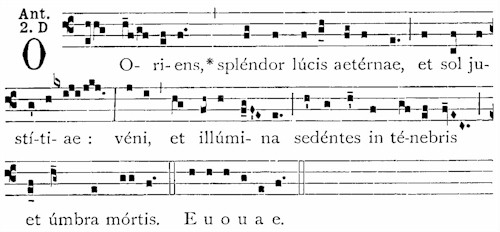
O Oriens, splendor lucis ætérnæ et sol iustítiæ: veni, et illúmina sedéntes in ténebris et umbra mortis.Monastic Diurnal:
O Dayspring, brightness of eternal Light and Sun of Justice: come and enlighten them that sit in darkness and in the shadow of death.
Divine Office (UK, Ireland & Australia):
O Rising Sun, you are the splendour of eternal light and the sun of justice. O come and enlighten those who sit in darkness and in the shadow of death.
J.M. Neale:
O come, thou Day-spring, come and cheer
Our spirits by thine advent here;
Disperse the gloomy clouds of night,
And death's dark shadows put to flight.
T.E. Lacey:
O come, o come, thou Dayspring bright!
Pour on our souls they healing light;
Dispel the long night's lingering gloom,
And pierce the shadows of the tomb.
Scripture:
For she is a reflection of eternal light (candor est enim lucis æternæ), a spotless mirror of the working of God. - Wisdom 7:26
The people who walked in darkness have seen a great light; those who dwelt in a land of deep darkness on them has light shined. - Isaiah 9:2
I am the LORD, I have called you in righteousness, I have taken you by the hand and kept you; I have given you as a covenant to the people, a light to the nations, to open the eyes that are blind, to bring out the prisoners from the dungeon, from the prison those who sit in darkness. - Isaiah 42:6-7
And you child, will be called the prophet of the Most High; for you will go before the Lord to prepare his ways, to give knowledge of salvation to his people in the forgiveness of their sins, through the tender mercy of our God, when the day shall dawn upon us from on high to give light to those who sit in darkness and in the shadow of death, to guide our feet into the way of peace. - Luke 1:76-79
Wednesday, December 19, 2007
O Clavis David - O Key of David - 20th December
Video; Audio .rm (with notation); Audio .mp3; Notation.
O clavis David, et sceptrum domus Israel; qui áperis, et nemo claudit; claudis, et nemo áperit: veni et educ vinctum de domo cárceris, sedéntem in ténebris et umbra mortis.
Monastic Diurnal:
O Key of David and Sceptre of the house of Israel. Who dost open and no man shutteth, Who dost shut and no man openeth; come and lead forth from his prison the captive sitting in darkness and in the shadow of death.
Divine Office (UK, Ireland and Australia):
O key of David and sceptre of Israel, what you open no one else can close again; what you close no one can open. O come to lead the captive from prison; free those who sit in darkness and in the shadow of death.
J.M. Neale:
O come, thou Key of David, come,
And open wide our heav'nly home;
Make safe the way that leads on high,
And close the path to misery.
T.E. Lacey:
O come, thou Lord of David's Key!
The royal door fling wide and free;
Safeguard for us the heavenward road,
And bar the way to death's abode.
Scripture:
The oracle of Balaam the son of Beor, the oracle of the man whose eye is opened, the oracle of him who hears the words of God, and knows the knowledge of the Most High, who sees the vision of the Almighty, falling down, but having his eyes uncovered: I see him, but not now; I behold him, but not nigh: a star shall come forth out of Jacob, and a sceptre shall rise out of Israel; it shall crush the forehead of Moab, and break down all the sons of Sheth. - Numbers 24:15-17
But there will be no gloom for her that was in anguish. In the former time he brought into contempt the land of Zebulun and the land of Napthali, but in the latter time he will make glorious the way of the sea, the land beyond the Jordan, Galilee of the nations. The people who walked in darkness have seen a great light; those who dwelt in a land of deep darkness on them has light shined. - Isaiah 8:23-9:1
Jesus headquartered his ministry at Capernum (Matthew 4:13) on the border between Zebulun and Napthali - the first of the tribal territories to be ravaged by the Assyrians (2 Kings 15:29) and so a the place for Jesus to start his ministry to the "lost sheep of the house of Israel" (Matthew 15:24) as opposed to just the faithful tribe of Judah. By the time of Jesus this territory, Galilee, was home to gentiles, truly Galilee of the nations. (See Scott Hahn's printed and audio commentaries on Matthew).
And I will place on his shoulder the key of the house of David; he shall open, and none shall shut; and he shall shut, and none shall open. - Isaiah 22:22
I am the LORD, I have called you in righteousness, I have taken you by the hand and kept you; I have given you as a covenant to the people, a light to the nations, to open the eyes that are blind, to bring out the prisoners from the dungeon, from the prison those who sit in darkness. - Isaiah 42:6-7
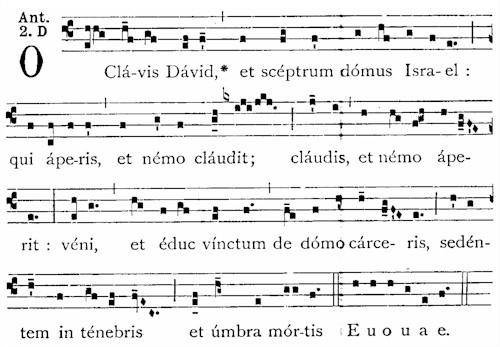
O clavis David, et sceptrum domus Israel; qui áperis, et nemo claudit; claudis, et nemo áperit: veni et educ vinctum de domo cárceris, sedéntem in ténebris et umbra mortis.
Monastic Diurnal:
O Key of David and Sceptre of the house of Israel. Who dost open and no man shutteth, Who dost shut and no man openeth; come and lead forth from his prison the captive sitting in darkness and in the shadow of death.
Divine Office (UK, Ireland and Australia):
O key of David and sceptre of Israel, what you open no one else can close again; what you close no one can open. O come to lead the captive from prison; free those who sit in darkness and in the shadow of death.
J.M. Neale:
O come, thou Key of David, come,
And open wide our heav'nly home;
Make safe the way that leads on high,
And close the path to misery.
T.E. Lacey:
O come, thou Lord of David's Key!
The royal door fling wide and free;
Safeguard for us the heavenward road,
And bar the way to death's abode.
Scripture:
The oracle of Balaam the son of Beor, the oracle of the man whose eye is opened, the oracle of him who hears the words of God, and knows the knowledge of the Most High, who sees the vision of the Almighty, falling down, but having his eyes uncovered: I see him, but not now; I behold him, but not nigh: a star shall come forth out of Jacob, and a sceptre shall rise out of Israel; it shall crush the forehead of Moab, and break down all the sons of Sheth. - Numbers 24:15-17
But there will be no gloom for her that was in anguish. In the former time he brought into contempt the land of Zebulun and the land of Napthali, but in the latter time he will make glorious the way of the sea, the land beyond the Jordan, Galilee of the nations. The people who walked in darkness have seen a great light; those who dwelt in a land of deep darkness on them has light shined. - Isaiah 8:23-9:1
Jesus headquartered his ministry at Capernum (Matthew 4:13) on the border between Zebulun and Napthali - the first of the tribal territories to be ravaged by the Assyrians (2 Kings 15:29) and so a the place for Jesus to start his ministry to the "lost sheep of the house of Israel" (Matthew 15:24) as opposed to just the faithful tribe of Judah. By the time of Jesus this territory, Galilee, was home to gentiles, truly Galilee of the nations. (See Scott Hahn's printed and audio commentaries on Matthew).
And I will place on his shoulder the key of the house of David; he shall open, and none shall shut; and he shall shut, and none shall open. - Isaiah 22:22
I am the LORD, I have called you in righteousness, I have taken you by the hand and kept you; I have given you as a covenant to the people, a light to the nations, to open the eyes that are blind, to bring out the prisoners from the dungeon, from the prison those who sit in darkness. - Isaiah 42:6-7
O Radix Jesse - O Root of Jesse - 19th December
Video; Audio .rm (with notation); Audio .mp3; Notation.
O radix Iesse, qui stas in signum populórum, super quem continébunt reges os suum, quem gentes deprecabúntur: veni ad liberándum nos, iam noli tardáre.
The Monastic Diurnal:
O Root of Jesse, who dost stand for an enseign of the people, before Whom kings shall remain silent, and unto Whom the Gentiles shall make supplication: come to deliver us and delay not.
The Divine Office (UK, Ireland and Australia):
O stock of Jesse, you stand as a signal for the nations; kings fall silent before you whom the peoples acclaim. O come to deliver us, and do not delay.
J.M. Neale (1818-1866):
O come, thou Rod of Jesse, free
Thine own from Satan's tyranny;
From depths of hell they people save
And give them victory o'er the grave.
T.A. Lacey (1853-1931):
O come, thou Branch of Jesse! draw
The quarry from the lion's claw;
From the dread caverns of the grave,
From nether hell, thy people save.
Scripture:
There shall come forth a shoot from the stump of Jesse, and a branch shall grow out of his roots...In that day the root of Jesse shall stand as an ensign to the peoples; him shall the nations seek, and his dwellings shall be glorious. - Isaiah 11:1,10.
Thus says the LORD: "The wealth of Egypt and the merchandise of Ethiopia, and the Sabeans, men of stature, shall come over to you and be yours, they shall follow you; they shall come over in chains and bow down to you. They will make supplication to you, saying: 'God is with you only, and there is no other, no god besides him.'" - Isaiah 45:14.
As many were astonished at him - his appearance was so marred, beyond human semblance, and his form beyond that of the sons of men - so shall he startle many nations; kings shall shut their mouths because of him; for that which has not been told them they shall see, and that which they have not heard they shall understand. - Isaiah 52:14-15.
And further Isaiah says "The root of Jesse shall come, he who rises to rule the Gentiles; in him shall the Gentiles hope." - Romans 15:12.
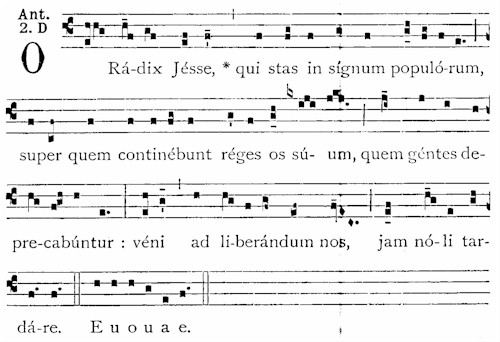
O radix Iesse, qui stas in signum populórum, super quem continébunt reges os suum, quem gentes deprecabúntur: veni ad liberándum nos, iam noli tardáre.
The Monastic Diurnal:
O Root of Jesse, who dost stand for an enseign of the people, before Whom kings shall remain silent, and unto Whom the Gentiles shall make supplication: come to deliver us and delay not.
The Divine Office (UK, Ireland and Australia):
O stock of Jesse, you stand as a signal for the nations; kings fall silent before you whom the peoples acclaim. O come to deliver us, and do not delay.
J.M. Neale (1818-1866):
O come, thou Rod of Jesse, free
Thine own from Satan's tyranny;
From depths of hell they people save
And give them victory o'er the grave.
T.A. Lacey (1853-1931):
O come, thou Branch of Jesse! draw
The quarry from the lion's claw;
From the dread caverns of the grave,
From nether hell, thy people save.
Scripture:
There shall come forth a shoot from the stump of Jesse, and a branch shall grow out of his roots...In that day the root of Jesse shall stand as an ensign to the peoples; him shall the nations seek, and his dwellings shall be glorious. - Isaiah 11:1,10.
Thus says the LORD: "The wealth of Egypt and the merchandise of Ethiopia, and the Sabeans, men of stature, shall come over to you and be yours, they shall follow you; they shall come over in chains and bow down to you. They will make supplication to you, saying: 'God is with you only, and there is no other, no god besides him.'" - Isaiah 45:14.
As many were astonished at him - his appearance was so marred, beyond human semblance, and his form beyond that of the sons of men - so shall he startle many nations; kings shall shut their mouths because of him; for that which has not been told them they shall see, and that which they have not heard they shall understand. - Isaiah 52:14-15.
And further Isaiah says "The root of Jesse shall come, he who rises to rule the Gentiles; in him shall the Gentiles hope." - Romans 15:12.
Subscribe to:
Posts (Atom)